New France
Settlers and Native peoples meet.
New France

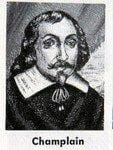
In 1534, under the reign of Francis I, Jacques Cartier took possession of Canada. With Samuel de Champlain, in 1608 during the reign of Henry IV, France made it a colony: New France. The lucrative fur trade soon took hold. Beaver and other wild animal fur was used to make the felt from which hats were made – hats that everyone in Europe wore at the time.
The Native peoples welcomed the newcomers, helped them settle and shared their knowledge of the country with them. The French thus learned from the Indians the techniques of hunting, trapping and survival in America's immense forests. The first French trappers, known as coureurs des bois or voyageurs, spread out across the Great Lakes region and made contact with new tribes.
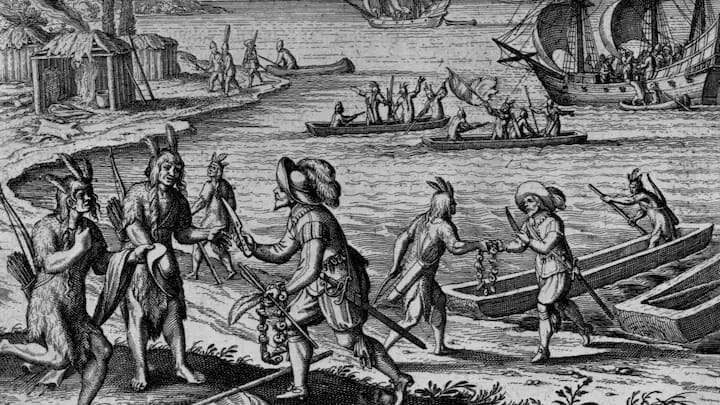
The fur traders in turn encouraged the Indians to trap more and more animals to meet growing demand. The trade took the form of barter. The French introduced metal tools and implements – knives, hatchets, needles, various containers – as well as glass beads, fabrics and ribbons.
The Marquette and Jolliet expedition
Towards unknown lands and peoples
This trade put the French in competition with the English, who were also established in that part of the world. New markets had to be found. China came to mind. The idea took shape of crossing the American continent from east to west to reach the Pacific Ocean. Only the river route was feasible through the impenetrable tangle of forest that America then was.
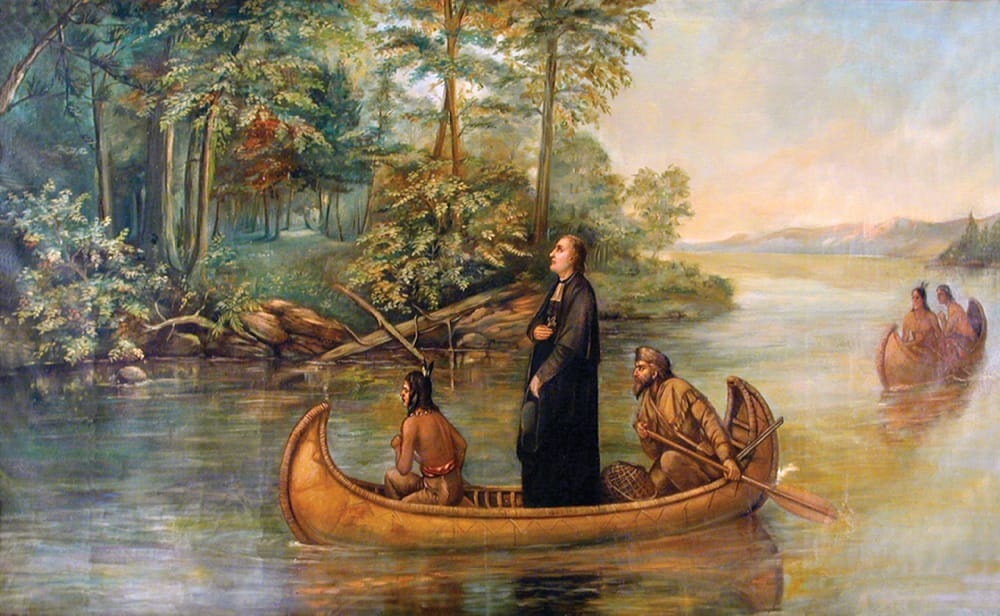
In 1673 the Jesuit Jacques Marquette and the explorer Louis Jolliet set out from Lake Superior, hoping that the Mississippi would lead west and flow into the Pacific. Travelling down the river in two canoes, they mapped the area, collected plants and met unknown tribes. But they eventually discovered that the Mississippi flows south, not west.
On reaching the Arkansas River, Illinois Indians told them that the river continued south-west, towards a region they called "Wha-Sha-She", which Marquette noted as "Osage". Fearing to enter Spanish territory, Marquette decided to turn back and return to New France.
This was the first written mention of the Osages by a European: the shared history was only just beginning. Next: Louisiana »