The great Osage chiefs
Portraits of figures who shaped the history of the Osage Nation.
Ne-Kah-Wah-She-Tun-Kah
A man of courage and a prestigious Osage chief
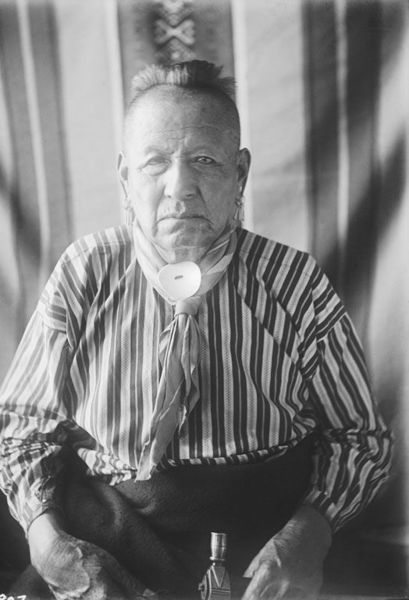
"Courageous man" is the translation of his Osage name. He was born in 1839 on the Osage reservation. He was the last traditional chief. He was subsequently elected four times as Principal Chief of the Osage Nation. All his life he strove to act for the well-being of his people, and he is therefore greatly respected. He is affectionately nicknamed "Uncle Nick".
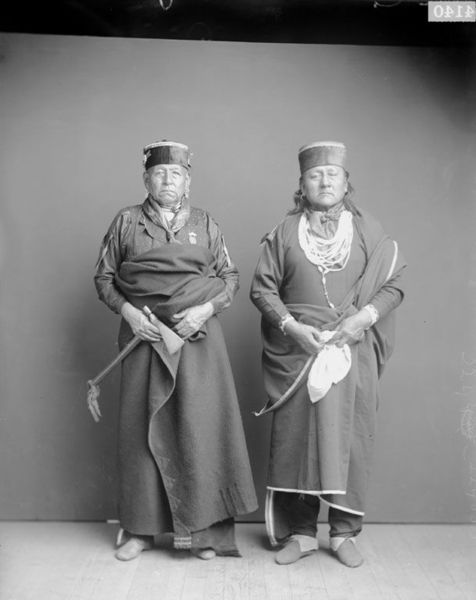
"Uncle Nick" died on 3 August 1923. His funeral was a traditional ceremony according to Osage rites. His favourite horse was sacrificed and a scalp was placed in the grave. This ritual was meant to allow the spirit of the dead chief to enter the "Happy Hunting Ground". The scalp had been taken from a Wichita chief named A-sa-wah. This act caused a severe conflict between the two tribes. The disturbances prompted the United States government to ban all scalp-hunting in future. It was the last traditional burial.
In the end, to appease the Wichita's anger, the Osages compensated them with a large sum of money and gifts in kind.
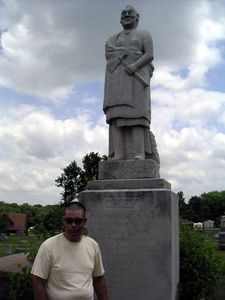
Soldier of the Oak
A solid and unyielding chief
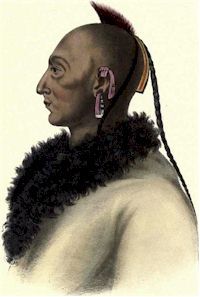
His Osage name has been forgotten. Only his French name, Soldat du Chêne ("Soldier of the Oak"), is still known, underlining once more the influence of French culture on the Osage people in the days of French Louisiana. It is said he was given the name after a furious battle in which, severely threatened by several enemies, he drove them back by taking refuge behind an oak tree. This did not prevent him from becoming chief of the Osages.
It was in this capacity that he was invited in 1805 to visit the President of the United States in Philadelphia. His portrait was painted on that occasion and is still held at the American Philosophical Society.
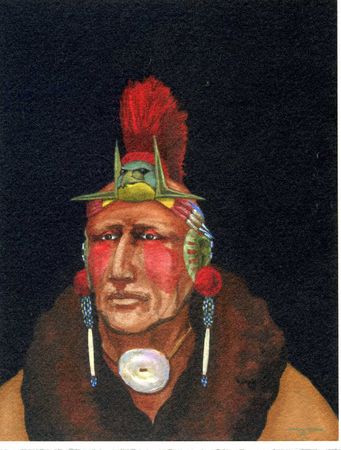
Soldier of the Oak is perhaps also known for another anecdote, told in Laura Ingalls's autobiographical novel and adapted for television in Little House on the Prairie. At that time the Ingalls family had settled in Kansas near the town of Independence, close to the Oklahoma border. The little house on the prairie is still there and can be visited.
The Ingalls were a farming family who, with other settlers, occupied Indian land. The tribes were determined to attack them, kill the families, burn the farms – in short, free their territory. It took all the authority of Chief Soldier of the Oak, surrounded by his warriors, to persuade them to abandon their plan. The impressive Osage warriors, often some 2 metres tall, quickly overcame any objections. Thanks to Soldier of the Oak, Laura Ingalls and her family were spared. This is apparently what can be seen in an episode of the series.
Pawnee-No-Pa-She
He who is not afraid of the Pawnee – a great chief of the Osage tribe
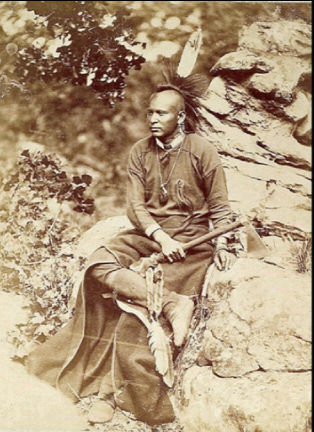
In December 1869, on the death of Little White Hair, the last hereditary chief of the White Hair line, Star Chief was appointed chief of the Osages. He soon became popular under several names: Pawnee No Pa She ("He-who-is-not-afraid-of-the-Pawnee"), Governor Joe, or Joe Big Hill.
The son of a war chief, Pawnee No Pa She had received a full education at Father Schoenmakers's Catholic mission in Kansas. At the end of his studies he surprised everyone by declaring that, despite his years of training in white culture, he remained deeply Osage. He then took off his "civilised" clothes and put his traditional loincloth back on. He mastered both English and Osage, which made him a valuable interpreter and a defender of his people.
In 1878 he was elected governor of the tribe, becoming the first democratically elected Osage chief. He worked to defend his people's rights: he asked that the Osages be allowed to continue hunting buffalo outside their reservation and that the reservation remain closed to outsiders. But his efforts failed: the buffalo quickly disappeared and pressure from settlers increased.
Physically imposing and highly educated, Pawnee No Pa She commanded respect. A famous anecdote tells how one day he came upon a couple of intruders camping illegally on Osage land. After eating with them in silence, he sent them away without violence. But as they were leaving, he caught up with them and warned them in impeccable English: if they came back, they would be arrested and tried under Osage law. Terrified, they never returned.
Pawhuska, White Hair
Why is the Osage capital called Pawhuska (Oklahoma)?
The nickname comes from a surprising episode at the Battle of the Wabash in 1791, where a coalition of Native American tribes inflicted a heavy defeat on General St. Clair's American army. In the thick of the fighting, Iron Collar tried to scalp an American officer, but what he tore off was in fact… a powdered wig. Convinced he had taken a magical object, he kept the wig attached to his belt. That is how he earned the nickname White Hair, which the Americans turned into Pawhuska.
This charismatic chief had already had other adventures: in the 1780s he led a small group of warriors to the Pacific, crossing the United States on foot. On the way, one of the members died after being bitten by a venomous lizard, a "Gila monster". Despite the dangers, they reached the California coast.
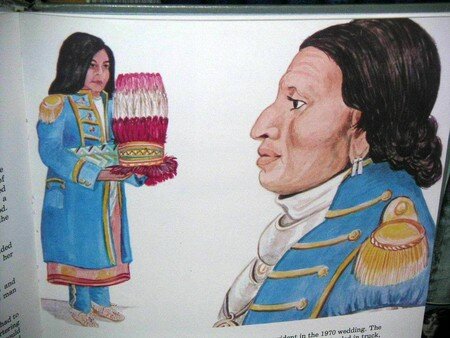
In 1806 Pawhuska was part of a delegation received by President Thomas Jefferson in Washington. The Osages often understood French, the language of their former allies, but refused to learn English. Jefferson therefore addressed them in French in a paternalistic tone, calling them "children" and stressing peace and unity among peoples.
After the visit, Pawhuska received a medal and a blue military tunic with braiding. Instead of wearing it as a trophy, he got creative: he turned the jacket into a wedding outfit for a young bride, blending Native traditions with elements of white prestige. The outfit also included a blanket, beaded moccasins and, above all, a top hat adorned with feathers, a symbol of dignity.
This anecdote, both funny and inventive, shows White Hair's personality: cunning, respected, bold and able to subvert Western codes without ever renouncing his identity. Today the town of Pawhuska perpetuates his name and legacy. Ironically, more than two centuries after his death, this Osage chief remains far more famous than many American presidents.
James Bigheart
The diplomat of six languages
In 1881, at a great council, James Bigheart, a respected Osage chief, proposed creating an official tribal government. He was elected chairman of the committee tasked with drafting a constitution. Like Paw-ne-no-pashe, he had studied at Father Schoenmakers's mission, but unlike him he had remained Catholic and had not returned to traditional life. A former Union Army lieutenant in the Civil War, he spoke six languages (including Osage, French and English) and worked as an interpreter.
The constitution established a National Council able to levy taxes, interpret treaties and serve as a court. In 1882 the Osages held their first elections by universal male suffrage. Paw-ne-no-pashe was elected principal chief, Strike Axe became his assistant, and Bigheart sat on the council.
Thanks to income from pasture leases to Texan ranchers, the Osages lived comfortably without having to farm. But from the 1890s the American government pressed to divide the reservation into private lots, a necessary condition for the creation of the State of Oklahoma. In 1893 an Osage committee, including Bigheart and his son, firmly rejected the plan because it violated the tribal constitution. Another worry was growing: many non-Indians, sometimes fraudulently enrolled on the tribal lists, already lived on the reservation. In 1904 there were between 10,000 and 15,000 of them, while the Osages numbered only 2,200.
Chief Black Dog
When the buffalo fell, the Osages rose
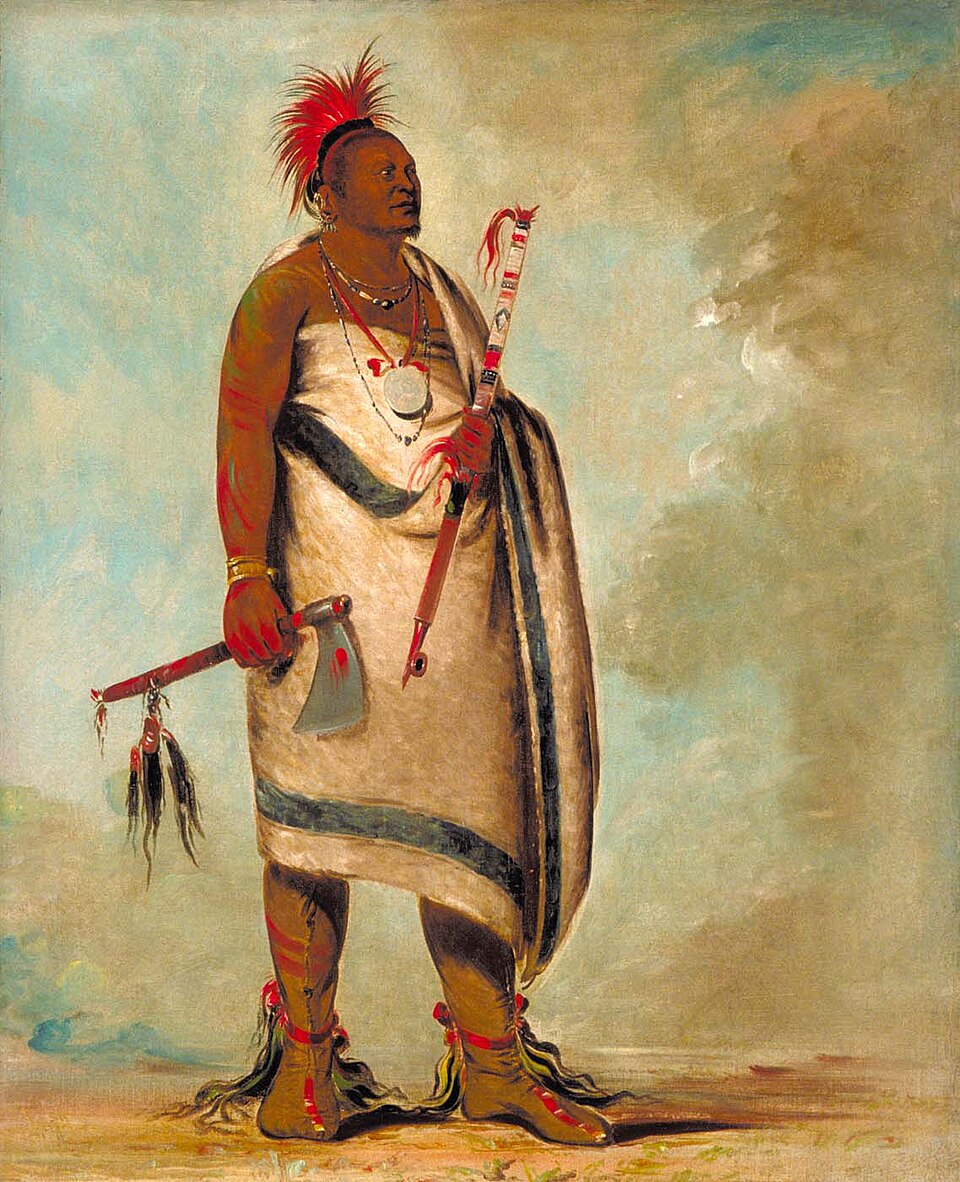
Between 1870 and 1875, buffalo – the Osages' main source of food – were slaughtered en masse by white hunters, purely for their hides or for sport. Their disappearance caused widespread famine. Faced with this crisis, some Osages turned to Gibson, the Indian agent, for help. Others tried to become farmers, but in 1873 and 1874 their crops were ravaged by gigantic locust invasions, plunging them into despair.
Despite favourable natural resources (pastures and thousands of ponies), stock-raising was not supported by Gibson or his successors. Their only aim was to turn warriors into settled farmers, regardless of the Osages' wishes or skills. Those who resisted this vision were despised and labelled "blanket Indians", a pejorative term for those who, according to the agents, refused to adapt.
Among them, Tchong-tas-sab-bee, nicknamed Black Dog, was one of the most respected chiefs. A one-eyed giant of more than 2.10 metres and 136 kilos, he embodied Osage strength and dignity. His band, firmly led, gave Gibson's administration a great deal of trouble.
Clermont, chief of the Osages
Hereditary chief of the Osages
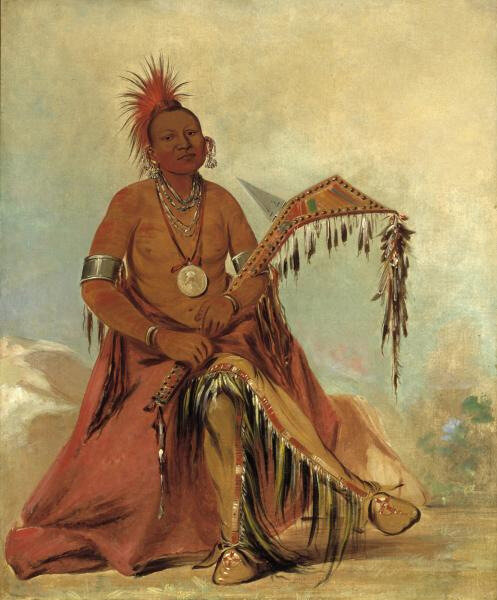
At the end of the 18th century, as the Osages split into several factions because of trade tensions between the French and the Spanish, one chief emerged as a central figure: Clermont. Heir to traditional power, Clermont was named chief of the Great Osages, succeeding his father, also a respected chief, with the tribe's agreement.
Settled with his people near the present-day town of Claremore, which bears his name, Clermont became a symbol of unity and resistance. In a context of mounting territorial conflicts, he opposed the Western Cherokees, recently displaced, who also claimed the hunting grounds around the Arkansas River. This struggle for territory led to one of the most violent clashes in Oklahoma's history: in October 1817 Clermont's village was attacked and burned by a band of heavily armed Cherokee warriors. The chief and his people suffered a heavy defeat: the village was destroyed and dozens of prisoners were taken.
A few years later, the Osage chiefs, weakened by conflict and growing pressure from the American government, were forced to cede their lands by a treaty signed in St. Louis in 1825. The signing marked the start of a new exile, first to Kansas, then to a new reservation purchased from the Cherokees in northern Oklahoma.
Clermont was not only a political and warrior leader. His image has survived thanks to the famous painter George Catlin, who painted his portrait around 1830. He describes him as an impressive young man in ceremonial dress, his leggings trimmed with locks of scalps, firmly holding his war club – a feared weapon and a symbol of authority. In this portrait Catlin immortalises the dignity, pride and strength of the whole Osage people.
A charismatic chief and defender of Osage land and identity, Clermont remains an emblematic figure of Indigenous resistance to colonial expansion and dispossession.